The Conventional Space of Human Life
Where Can We Actually Live?
Earth is our planet. It seems obvious that we can live on it — after all, we have been doing so for hundreds of thousands of years. But if we ask a more precise question: how large is the actual space in which humans can live and work without complex life-support systems, the answer becomes far less obvious.
This is not about places humans visit incidentally — altitude records, deep dives, or underground exploration. It is about the space in which human biology functions independently, without a technological prosthesis of the environment.
Biological Limits of Functioning
The human body is not universally adapted. Our bodies operate within a narrow range of conditions: temperature, pressure, atmospheric composition, and access to oxygen. Crossing these limits requires technology — from simple tools to complex life-support systems.
Let us assume functional, biological limits of the vertical space of life:
+5.5 km above sea level — the upper limit at which humans can live and work without breathing apparatus. This is not a record altitude, but a practical boundary of sustained functioning. There are human settlements at such elevations; people are born there, grow up, and work.
−1 km below the land surface — the practical limit of work without active ventilation and cooling systems. Deeper than that, temperature and the lack of natural air circulation require technical infrastructure.
Together: approximately 6.5 km of vertically biologically accessible space.
These assumptions are simplified, but they are based on real physiological constraints, not on arbitrary records or exceptional achievements.
What We Exclude — and Why It Matters
Water
The interior of seas and oceans is excluded from the space of life in this model, because humans cannot function underwater without life-support equipment. By contrast, the airspace above the oceans — from the surface up to about 5.5 km in altitude — meets the same atmospheric criteria as the space above land. A person on a raft, a boat, or a platform breathes just as freely as in a desert.
This is not because we cannot dive — of course we can. But:
- We do not breathe underwater
- We do not move freely
- We cannot work, build, or live there continuously
Water is a biologically incompatible environment. Even shallow diving is a temporary exploration, not life. Humans require equipment after just a few dozen seconds below the surface. We therefore exclude the volume of water, not the space above it.
The Poles
Polar regions function in practice as extreme environments in which humans always require technical infrastructure. It is not that humans do not go there — of course they do; there are research stations and expeditions. But it is technology that enables life there, not natural conditions.
For the sake of simplifying calculations, polar regions are treated as the boundary of biologically compatible space. This is not a geopolitical or geographic judgment — it is a physiological observation.
Deserts, Taiga, Jungles
It might seem that if we exclude the poles, we should also exclude the Sahara, the Siberian taiga, or the Amazon rainforest. No.
Accessibility does not mean comfort or environmental friendliness. It means only the biological possibility of living and working without a technological prosthesis of the environment.
People live in the Sahara. People live in the taiga. People live in the Amazon. They live there without air conditioning, without hermetic sealing, without breathing apparatus. The conditions are harsh, but human biology remains compatible with them. This is not an assessment of quality of life — it is a matter of physiological compatibility.
Uninhabited areas are not the same as biologically inaccessible areas.
The Layer of Life vs. the Layer of Functioning
Although the limits of +5.5 km upward and −1 km downward do not yet require life-support equipment, this does not mean that they constitute a natural space of everyday human functioning.
The real space of human life on Earth lies in a layer from 0 to about 2 meters above the ground surface. It is within this layer that we:
- walk
- sleep
- work
- breathe
- function without technological intermediaries
Everything beyond it is already a technological extension.
One can climb a tree — that is a few meters. One can build a tower — that is hundreds of meters. One can descend into a mine — that is hundreds of meters downward. But every step away from this thin layer requires increasingly complex technology to enable functioning:
- A few to a dozen meters → buildings, structures
- Hundreds of meters → elevators, installations, load-bearing systems
- Kilometers downward → ventilation, cooling, transport
- Kilometers upward → hermetic sealing, pressure control, environmental control
The closer we get to the biological limits (5.5 km upward, 1 km downward), the more technology ceases to be support — and becomes a condition for survival.
The boundary between a “naturally compatible” environment and a “technologically sustained” one is not a sharp line, but a continuous transition. Buildings, ships, and mines compensate for environmental conditions. Suits and oxygen systems replace the environment itself.
The Question of Volume
With these biological limits — +5.5 km upward (above land and oceans), −1 km downward below land surface, excluding the interior of bodies of water and polar regions — we can ask a simple geometric question:
What volume, in cubic kilometers, does this space of life occupy compared to the entire Earth?
This is not a philosophical question. It is a computational one. And the answer is surprising.
On the Limits of Simplification
Of course, this model can be refined further. In reality, the boundaries of biologically accessible space depend on local conditions: soil type, availability of natural ventilation, ground stability, or proximity to water. A few dozen meters from a coastline, it is no longer possible to dig a one-kilometer-deep shaft without advanced infrastructure. At certain depths, air ceases to circulate naturally, and temperature forces active cooling. The same applies to polar regions — their exclusion does not result from planetary geometry, but from human physiology and the necessity of constant technological support.
All of these nuances are deliberately omitted here. What matters at this stage is the first approximation: the global scale of biologically compatible human living space.
The very topic of the space in which humans can function on Earth turns out to be broad and surprising enough that I will return to it in a future article.
Part 2: Calculations
The Volume of the Earth
Earth is a sphere with a radius of approximately 6,371 km. Its volume is calculated using the formula for the volume of a sphere:
V = (4/3) × π × r³
V = (4/3) × π × 6371³ ≈ 1.083 trillion km³
This is the full volume of the planet — from the core to the upper layers of the atmosphere. The whole of it.
The Volume of Living Space
We now calculate the volume of biologically accessible space. This is not a simple layer on the surface — it is a combination of several geometric elements.
Computational Assumptions
- Earth’s surface area: ~510 million km²
- Land surface area: ~149 million km² (29.2%)
- Ocean surface area: ~361 million km² (70.8%)
- Polar regions (approximation): ~28 million km² (5.5% of Earth’s surface)
- Land area excluding polar regions: ~121 million km²
- Ocean area excluding polar regions: ~333 million km²
- Earth’s surface excluding polar regions: ~482 million km²
Vertical range: +5.5 km upward, −1 km downward below land surface
The Layer Above the Surface (+5.5 km)
Air is available everywhere — above land and above oceans. A human breathes just as freely on a raft in the middle of the Pacific as in a desert. Therefore, we count the airspace above the entire surface of the Earth (excluding polar regions).
Volume of the +5.5 km layer above land and oceans (excluding polar regions):
V_upper = 482 million km² × 5.5 km = 2,651 million km³
The Layer Below the Surface (−1 km)
Subsurface space exists only beneath land, not beneath oceans (the ocean floor is biologically inaccessible).
V_lower = 121 million km² × 1 km = 121 million km³
Total Volume of Living Space
V_life = 2,651 + 121 = 2,772 million km³
Rounded: ~2.77 billion km³
Proportion
We can now calculate what percentage of Earth’s total volume this living space represents:
(2,772 million km³) / (1,083,000 million km³) × 100% = 0.256%
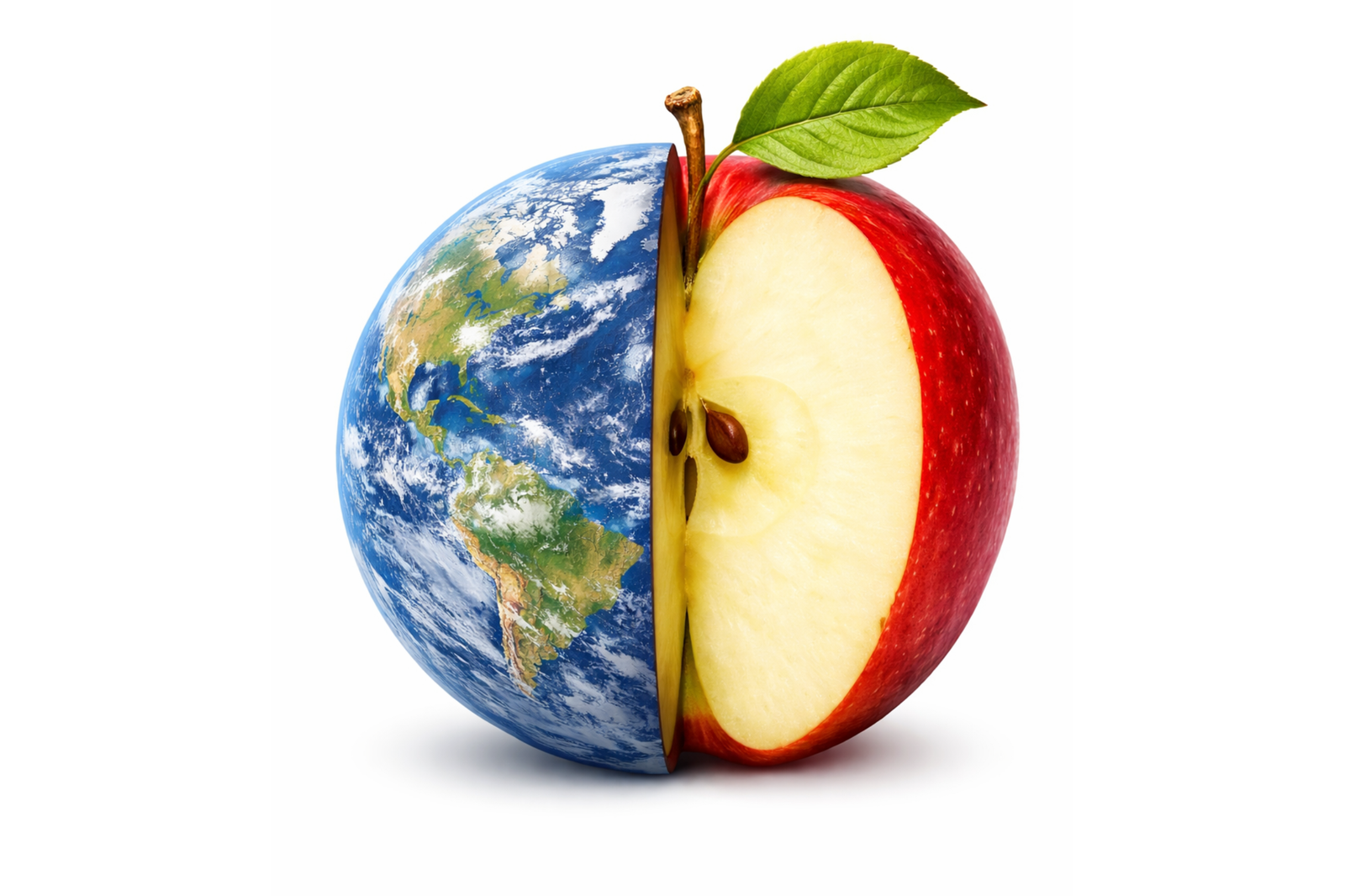
Human living space accounts for approximately 0.26% of Earth’s volume.
Or, put differently: about a quarter of one percent.
Or, put another way: roughly 1/390 of the planet’s volume.
Intuition Check
These numbers may seem abstract, so it is worth checking whether they make sense:
- Earth’s radius: 6,371 km
- Thickness of the living layer: 6.5 km
- Ratio: 6.5 / 6,371 ≈ 0.1%
Our result (0.26%) is slightly higher because we count the layer above the entire Earth’s surface excluding the poles, not just above land. If Earth were a sphere with a radius of 1 meter, the space of life would be a layer about one millimeter thick — spread over land and oceans, but extending underground only where land exists.
What This Means in Practice
2.77 billion cubic kilometers sounds like a lot. But in planetary terms, it is still a fraction of a percent.
All of human civilization — all cities, buildings, infrastructure, workplaces, homes, hospitals, factories, roads, farmland — fits within this thin layer. Not because we chose it that way, but because nowhere else allows us to function normally.
Every descent deeper, every ascent higher, every immersion in water requires technology. And the farther we move away from this layer, the more complex that technology must become.
Human living space on Earth is surprisingly limited.
Part 3: Perspective
The View from Orbit
Astronauts returning from space tend to say the same thing. From a distance of several hundred kilometers, they see something that cannot be seen from here, from the surface: how thin the layer of life really is.
The atmosphere appears as a blue rim on the planet’s horizon — a thin, delicate line separating life from vacuum. Edgar Mitchell, Apollo 14 astronaut, once said: “From this perspective, everything changes. You see this fragile ball of life hanging in the void.”
From orbit, it becomes clear that we do not live on Earth. We live within Earth — in a thin layer that clings to the surface like condensation on glass.
Fighting for a Fraction of a Fraction
All of human history can be described as a struggle for control over fragments of this thin layer.
Great empires — Roman, Mongol, British, Ottoman — fought for access to land, resources, and trade routes. Wars, conquests, expansions, colonies. All of it was a struggle over pieces of the same space — a quarter of a percent of the planet’s volume.
National borders, economic zones, disputed territories — all of these concern only the surface of land and water, only this accessible layer. No one fights for control of space 100 km beneath the ocean or 50 km above the surface. Because no one can live there.
All geopolitics is a struggle over a fraction of a fraction.
Your Map of the World
Maybe you travel. Maybe you fly airplanes. Maybe you’ve been to several continents. Maybe someone would say about you: “You know the world.”
But even if you have visited 50 countries, flown tens of thousands of kilometers, seen oceans, mountains, and deserts — you have still moved within the same thin layer. You have never left those 6.5 kilometers of vertical space.
An airplane cruising at 10 km? That is already outside the layer — a technologically extended presence. A dive to 30 meters? That is exploration of the boundary, not life.
The entire “world” you know is a quarter of a percent of the planet’s volume.
The Question of the Future
0.26% is not much.
All of human civilization — all eight billion people, all cities and infrastructure — fits into a space that constitutes a quarter of a percent of the planet. The rest is inaccessible to us without technology — or entirely inaccessible at all.
This is not a pessimistic judgment. It is a physical observation.
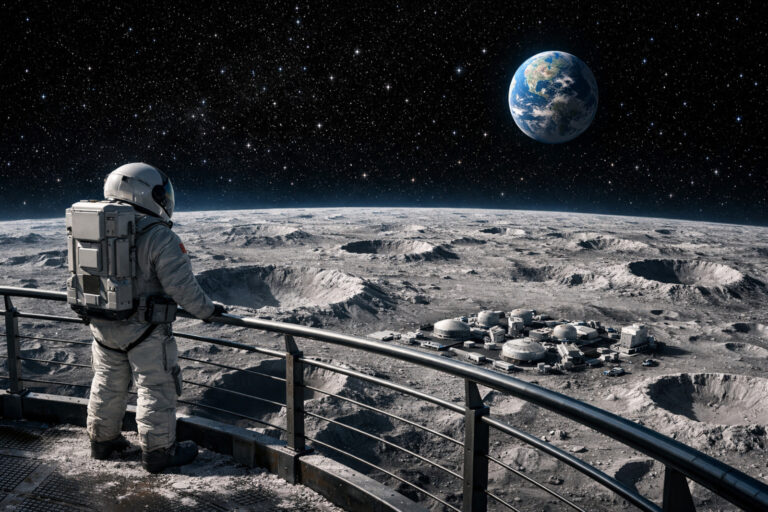
But the same observation leads to another question: if only 0.26% of Earth is accessible, then perhaps expansion into space is not a fantasy — but a logical consequence?
If we want more living space, there is only one direction left.
Upward.
And perhaps beyond this thin layer begin possibilities that we cannot even contemplate on Earth.