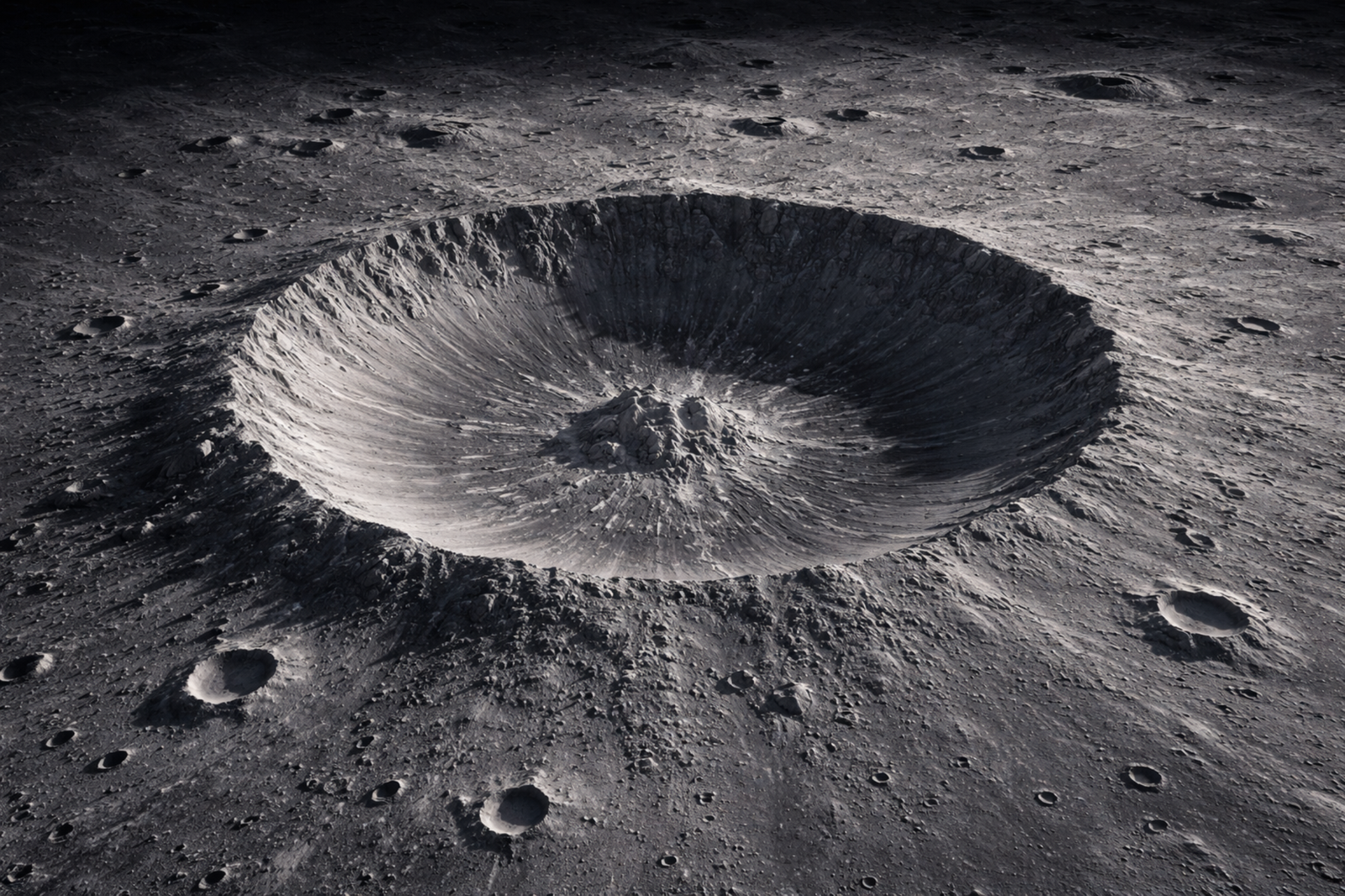
The Moon’s Surface as a Chronicle of Time
Earth erases its traces. The Moon does not.
Nothing on Earth lasts forever in its original form. Rain, wind, tectonics, water — they work together to keep every surface in constant motion. A meteor crater vanishes within millions of years. A human footprint — within minutes. The planet is alive, and because of that it endlessly forgets.
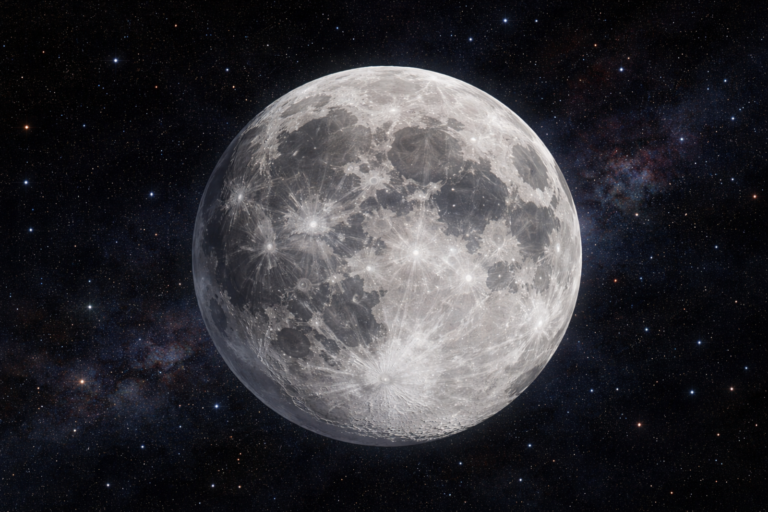
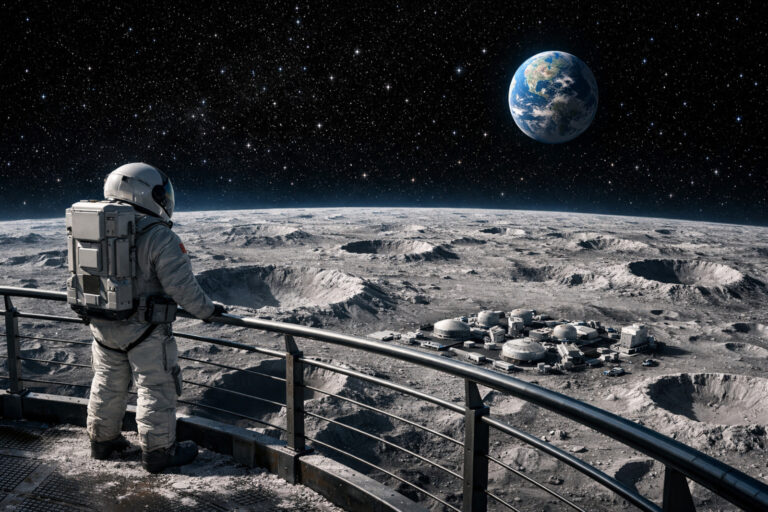
The Moon operates differently. It has no atmosphere, no liquid water on its surface, no active tectonics. Whatever lands there — stays. A crater formed three billion years ago looks almost identical today to one formed a thousand years ago, if both are similar in size. Neil Armstrong’s boot print from 1969 will still be there in a million years. And in ten million, unless something larger hits it.
But that’s just the thing — unless something hits it. Because the Moon is bombarded constantly. Every day. Every second. And it is this bombardment that is the subject of this article — not as a threat, but as a recording mechanism. The Moon’s surface is a chronicle of time. And it can be read, if you know how.
A rain that never stops
Imagine rain. But instead of water droplets — grains of rock, metal fragments, dust from disintegrated comets, asteroid shards. All of it moving at velocities between 3 and 72 km/s. There is no atmosphere to slow it down, brake it, or flatten it. Everything reaches the surface at full force.
Several thousand particles with a mass greater than one microgram — roughly the weight of a grain of sand — strike every square meter of the lunar surface each year. The Grün model (1985), still a foundational tool for engineers designing shielding for space missions, estimates approximately two impacts per year per square meter for particles heavier than one milligram — that is, particles a thousand times heavier. That sounds like very little. But multiply it across the entire surface of the Moon — 38 million square kilometers — and the number becomes astronomical.
The scale of bombardment shifts dramatically with the size of the impactor. A millimeter-sized object strikes a given square meter once every few million years — but the entire Moon several hundred times a day. A meter-sized object, weighing tens of kilograms, statistically strikes the Moon a few times a year. And here we are no longer talking about dust — we are talking about an event observable from Earth.
On March 17, 2013, NASA astronomers at the ALaMO observatory in Huntsville, Alabama, recorded a flash on the dark side of the Moon — a flash visible to the naked eye from Earth, lasting less than a second. A meteoroid weighing approximately 40 kilograms, traveling at 25.6 km/s, struck Mare Imbrium. A few weeks later, the Lunar Reconnaissance Orbiter confirmed it: a crater approximately 18 meters in diameter had formed. It was the first directly observed moment of birth of a new lunar crater in history. Since NASA began systematic monitoring in 2006, the ALaMO program has recorded over 330 such impacts.
Why a grain of sand is like a miniature explosive charge
To understand why micrometeorites matter — not just aesthetically, but physically — you need to pause at one number: 20 km/s. That is the average impact velocity for small particles. For comparison: a bullet fired from a pistol travels at about 0.4 km/s. A micrometeorite is therefore fifty times faster than a bullet.
Kinetic energy scales with the square of velocity — so at 50 times the speed, energy increases 2,500-fold. A grain of sand weighing one milligram, striking at 20 km/s, releases fifty times more energy than the same mass of TNT explosive. This is not a metaphor — it is a straightforward unit conversion.
⚙️ Engineering insert #1 — energy of a microimpact
Input data: particle mass m = 1 mg = 10⁻⁶ kg, velocity v = 20 km/s = 20,000 m/s
Kinetic energy: Ek = ½ · m · v² = ½ · 10⁻⁶ · (20,000)² = 200 J
For comparison:
- 9 mm pistol bullet: ~500 J
- 1 mg of TNT: ~4 J
- same mass at TNT detonation speed (~7 km/s): ~0.025 J
A 1 mg particle striking at 20 km/s carries 50 times more energy than the same material as TNT. Explosive charges work through gas expansion; hypervelocity impacts work through shock pressure and material plastification — but the energy is comparable. This explains why micrometeorites damage surface exposure even without a visible crater — the microfractures and crystal lattice degradation alone absorb those 200 J.
After billions of years of such bombardment, the result is visible to the naked eye. The Moon’s surface is covered with a layer of regolith — a material that is not ordinary sand, but the product of billions of years of impact processing. It is crushed, melted, re-solidified, and crushed again rock. Every stone returned by the Apollo missions had so-called “zap pits” on its upper surface — microscopic craters from impacts by cosmic dust particles. There was not a single stone free of these marks.
Impact gardening — the Moon plowing itself
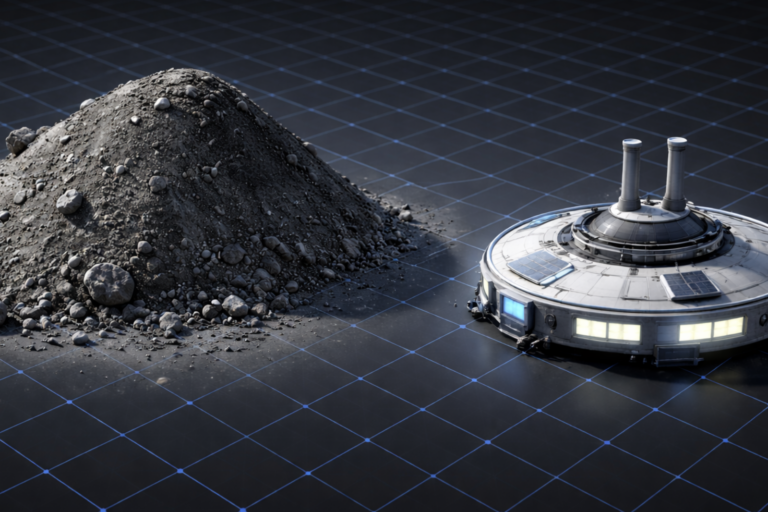
The term “impact gardening” sounds benign — gardening by impacts — but it describes one of the most fundamental processes shaping the Moon’s surface. It refers to the continuous mixing, burying, and exhuming of material by hundreds of millions of years of bombardment at every scale of size.
Arnold’s 1975 model, one of the first simulated models of this process, described the lunar regolith as a system that behaves according to the mathematical phenomenon of the “gambler’s ruin” — material at a given location accumulates slowly over thousands of years of small impacts, then a single larger impact overturns everything in a fraction of a second. The history of any particular piece of regolith is thus a leap through the ages: millions of years of calm, then sudden exhumation.
More recent models, calibrated against drill cores from Apollo 15, 16, and 17, have allowed precise measurement of the depth to which gardening reaches over different timescales. The results are as follows: the upper two centimeters of regolith are literally “reworked” over approximately two million years. Below one meter — the process is several orders of magnitude slower. Material at a depth of several meters may retain undisturbed stratigraphy from billions of years ago. This is precisely why the Apollo cores are so valuable — they extracted cross-sections through entire epochs.
⚙️ Engineering insert #2 — how long does it take for a one-meter crater to disappear?
Problem: we have a fresh crater with a diameter of 1 m and a depth of ~20 cm (a typical depth-to-diameter ratio for small craters is ~1:5). How long does it take for impact gardening to erase it?
Volume to fill: V = π · r² · h = π · 0.5² · 0.2 ≈ 0.157 m³
Gardening model (after Costello et al., 2021): The rate of regolith reworking as a function of depth d follows a power-law scaling. Upper 2 cm → ~2 million years. For linearly increasing depth, time scales with depth approximately as t ~ d^n, where n ≈ 2–3.
For d = 20 cm (depth of a 1 m crater): Scaling: (20 cm / 2 cm)^2.5 ≈ 10^2.5 ≈ 316 times longer
t ≈ 2 million years × 316 ≈ ~600 million years
Interpretation: a one-meter crater statistically disappears on the scale of hundreds of millions of years. A “young” crater for a lunar geologist may be 100 million years old. This applies to an isolated crater — in practice, many craters overlap and the timescale is shorter due to ejecta effects from neighboring impacts.
The conclusion is non-obvious: the Moon is not “frozen in time” in the naive sense of that phrase. Its surface is in continuous, very slow motion. But the timescale of that motion is so remote from human experience that for us it looks like a held breath.
CSFD — how craters become a clock
This is the heart of the entire article. The question “how old is this area of the Moon?” is fundamental to every mission — and the answer is hidden in counting craters.
The method is called Crater Size-Frequency Distribution — CSFD. Its logic is elegant in its simplicity: it assumes that meteorites strike randomly and uniformly across the entire lunar surface throughout its history. An older area had more time to collect craters of all sizes. A younger area — less. If we know the rate of crater formation as a function of size, we can read the age of a surface from its crater population as if from a page in a journal.
In practice, it works like this: we select an area of defined size, count craters in successive size bins (from a few meters to hundreds of kilometers), plot the results on a logarithmic chart — number of craters as a function of diameter. The result is a curve, which we compare against what is known as the Neukum Production Function (NPF). The NPF is a mathematical description of how many craters of a given size should form per unit area per unit time — calibrated against rock samples from Apollo, dated by radioisotope methods.
Fitting this curve to observational data yields an absolute age. The more craters relative to the values expected for a “fresh” surface — the older the area.
⚙️ Engineering insert #3 — crater density as a measure of age
Parameter N(1): the standard CSFD measure — number of craters with a diameter ≥ 1 km per 10⁶ km² of surface.
| Area | Age (Ga) | N(1) |
|---|---|---|
| Mare Imbrium (basalt) | ~3.2 | ~200 |
| Mare Tranquillitatis | ~3.6 | ~600 |
| Lunar highlands | ~4.0 | ~2000–3000 |
| Chang’e-5 landing area | ~2.0 | ~50 |
A ~10× difference in density between the maria and the highlands corresponds to a difference of ~0.8 billion years. The method has a resolution on the order of tens to hundreds of millions of years for old surfaces, and down to a few tens of millions of years for younger ones (e.g., Copernican/Eratosthenian volcanism).
Validation: CSFD dating of the Chang’e-5 landing area gave a result of 2.0 ± 0.2 Ga. Isotopic dating of the returned sample by the laboratory: 2.03 ± 0.004 Ga. Agreement within the margin of error — this is a calibration that works across billions of years.
Limitations: the NPF is defined for craters from 10 m to 300 km. Below 10 m, saturation effects and gardening degradation take hold — small craters disappear faster than they form, disrupting the statistics.
The CSFD method revolutionized planetary science. Before Apollo, there was no way to obtain absolute dating of planetary surfaces without a returned sample. Today we can date regions on Mars, Mercury, the moons of Jupiter and Saturn — wherever orbital data reveals craters — by comparison with the curve calibrated on Apollo lunar samples. The Moon has become the standard of distance in time for the entire Solar System.
Undisturbed subsurfaces and the paradox of “eternally buried”
Here arises one of the most fascinating paradoxes. On one hand: the Moon’s surface is in continuous motion, bombarded and reworked over billions of years. On the other: a few meters down — a silence lasting billions of years.
The Apollo drill cores revealed a stratigraphy that any terrestrial geologist would envy. Distinct layers separated by episodes of larger impacts. Material from a depth of three meters may retain a preserved sequence of deposits from 3.5 billion years ago, untouched by what happens at the surface. It is like reading the rings of a tree — except this “tree” is 4.5 billion years old.
There is also the question of “statistically undisturbed” areas — patches of surface that by pure chance have not received any impact above a certain size for billions of years. Mathematically: yes, such areas exist. In reality: the microscale reaches everywhere. Every square meter of lunar surface is struck by thousands of small particles each year. The regolith is “milled” everywhere. But the subsurface — that is a different story.
A chronicle, not a graveyard
The popular image of the Moon as a “dead celestial body” is misleadingly inaccurate. The Moon does not build mountains through tectonic uplift and does not carve valleys through river erosion — but it is continuously changing through bombardment. Every impact is an entry in the ledger. Every layer of regolith is a page from an epoch that no terrestrial rock can remember.
Reading this chronicle is one of the greatest achievements of planetary science in recent decades. You do not need a return mission and a sample to say “this area is 3.2 billion years old” — a good camera in orbit and Neukum’s methodology are enough. Artemis and future missions will not only explore — they will expand the calibration database that allows us to read the history of the entire Solar System written in craters.
And somewhere beneath it all, a few meters down, lie layers unchanged since the time Earth was still a frozen ball without life. Waiting for the drill.
Sources
- Grün E. et al. (1985), Collisional balance of the meteoritic complex, Icarus 62, 244
- Vanzani V. et al. (1997), Micrometeoroid impacts on the lunar surface, LPSC XXVIII — https://www.lpi.usra.edu/meetings/lpsc97/pdf/1025.PDF
- LunaRef — Meteoroid Flux — https://www.lpi.usra.edu/wiki/lunaref/index.php/Meteoroid_Flux
- Pokorný P. et al. (2019), Meteoroids at the Moon, JGR Planets — https://agupubs.onlinelibrary.wiley.com/doi/full/10.1029/2018je005912
- NASA ALaMO — 20 Years of Discovery (2026) — https://www.nasa.gov/blogs/watch-the-skies/2026/03/12/nasa-marshall-lunar-meteor-observatory-marks-20-years-of-discovery/
- Smithsonian Insider, interview with Bruce Campbell — https://insider.si.edu/2013/05/a-meteorite-explodes-on-the-moon-qa-with-geophysicist-bruce-campbell/
- Oetting A. et al. (2023), Slopes of Lunar CSFD, JGR Planets — https://agupubs.onlinelibrary.wiley.com/doi/full/10.1029/2023JE007816
- Michael G., Neukum G. (2010), Planetary surface dating from CSFD, ScienceDirect — https://www.sciencedirect.com/science/article/abs/pii/S0012821X1000004X
- Costello E. et al. (2021), Secondary Impact Burial and Excavation Gardening, JGR Planets — https://agupubs.onlinelibrary.wiley.com/doi/full/10.1029/2021JE006933
- Arnold J.R. (1975), Monte Carlo model for the gardening of the lunar regolith, The Moon 13, 159–172 — https://link.springer.com/article/10.1007/BF00567513
- Hu J. et al. (2024), Constraints on lunar regolith resurfacing, ScienceDirect — https://www.sciencedirect.com/science/article/abs/pii/S0016703724001820
- O’Brien D., Byrne P. (2021), Physical and Chemical Evolution of Lunar Mare Regolith, JGR Planets — https://agupubs.onlinelibrary.wiley.com/doi/abs/10.1029/2020JE006634
- Liu J. et al. (2023), New Lunar Crater Production Function, Remote Sensing MDPI — https://www.mdpi.com/2072-4292/15/9/2421
- Chang’e-5 CSFD dating (2023), Remote Sensing MDPI — https://www.mdpi.com/2072-4292/15/9/2463
- NASA SVS — Gardening Rates on the Moon (2016) — https://svs.gsfc.nasa.gov/4505/
Article prepared as part of the AI907 series — documentation of human–AI collaboration in the exploration of scientific knowledge.