
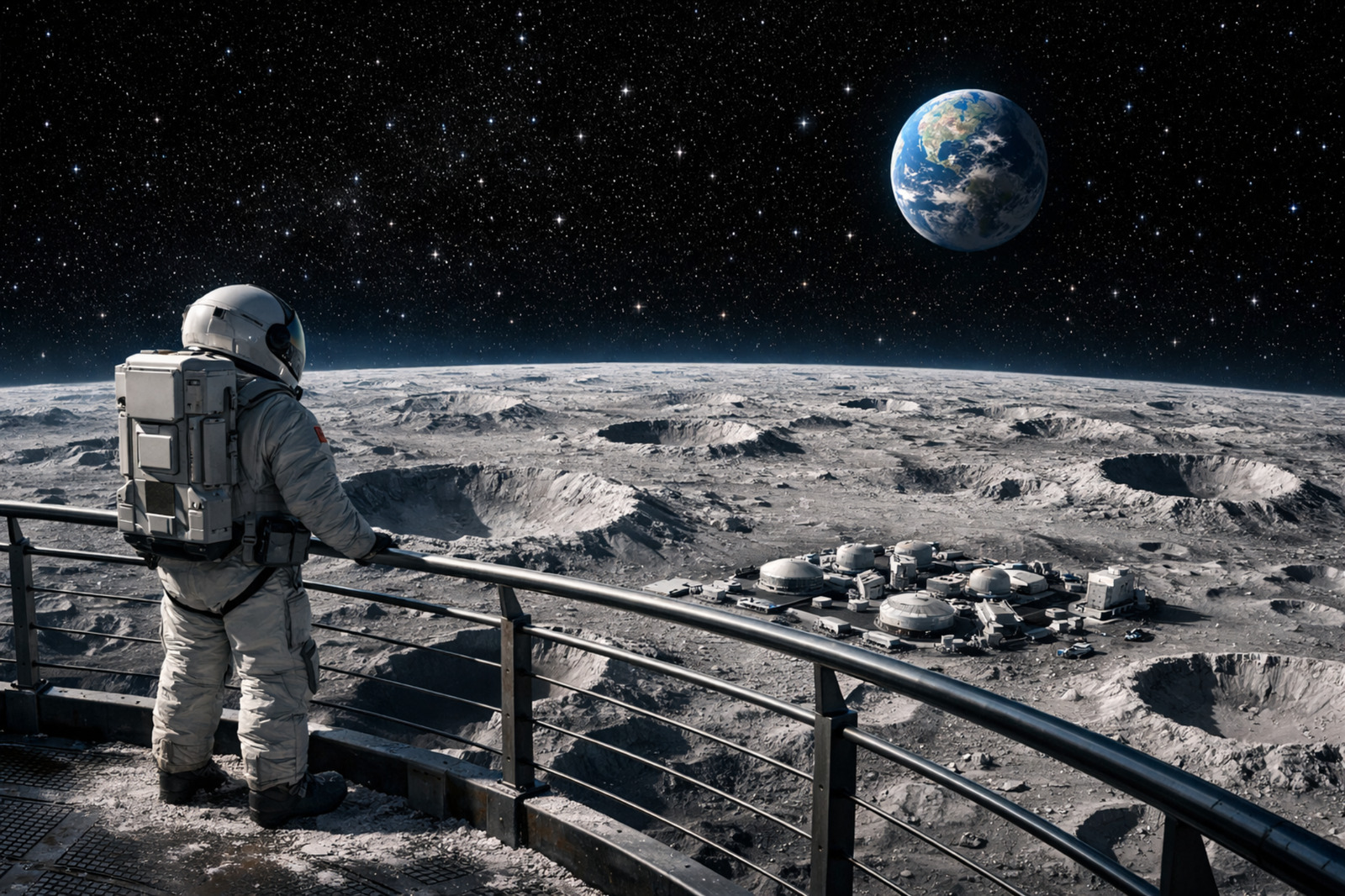
How High Can We Build on the Moon? Numbers, Physics, Perspectives
When we think about extremely tall structures (megastructures), we instinctively point to Burj Khalifa — over 800 meters tall, a symbol of the perceived boundary of what can be built. A boundary that, in everyday intuition, feels almost absolute. But what if we changed not the design… but the planet itself?
This text attempts to answer a seemingly simple question: how high can we build on the Moon? Not in an architectural or logistical sense, but in a physical and engineering one.
What This Article Is Not
I deliberately omit material transport, construction processes, long-term degradation, radiation, micrometeoroids, and costs.
These aspects are important — but they are not the focus of this analysis.
It is also worth noting that in many places this text goes beyond the popular-science level and enters the domain of simplified engineering analysis.
This is not an attempt to create a vision or an eye-catching scenario, but rather to structure the problem using physics and numbers.
What This Article Is
This is a thought experiment grounded in numbers, not a visionary essay. I focus on what truly limits the height of structures: gravity, self-weight, and material strength.
We start with Earth not to replicate it, but because it is the only reference point we all intuitively understand. The tallest structures were built under Earth’s gravity. On the Moon, however, the self-weight of a structure is more than six times lower, allowing for much lighter — even hollow — constructions, fundamentally changing the rules of the game.
And it is precisely at this point that the actual analysis begins.
Reference Point: Burj Khalifa and Earth-Based Intuition
The tallest structure ever built by humans is currently the Burj Khalifa — 828 meters high. In common perception, this represents a near-absolute limit: higher “is no longer worth it,” “cannot be done,” or “makes no sense.”
It is worth noting, however, that this skyscraper was built under very specific conditions:
- gravitational acceleration of 9.81 m/s²,
- the need to support its own weight as well as that of thousands of people,
- the requirement to integrate elevators, stairwells, and technical systems,
- an architectural design optimized for habitation, not for the pure height limit.
Does physics truly impose an unbreakable barrier here?
A Simple Equation That Explains a Lot
If we set aside architectural requirements and focus purely on mechanics, the height of a structure is — in a first approximation — limited by the material’s own weight. In its simplest form:
h_max = σ / (ρ · g)
Where:
- σ — compressive strength of the material,
- ρ — material density,
- g — gravitational acceleration.
This equation does not yet tell us how to build.
It only tells us when a material begins to lose the fight against its own mass — when the stress at the base exceeds the material’s strength.
Earth: Concrete Numbers
Let us substitute values for typical construction materials.
For structural steel:
- σ = 250 MPa = 250 × 10⁶ Pa
- ρ = 7,850 kg/m³
- g = 9.81 m/s²
h_max = (250 × 10⁶) / (7,850 × 9.81) ≈ 3,247 m ≈ 3.2 km
For concrete:
- σ = 30 MPa = 30 × 10⁶ Pa
- ρ = 2,400 kg/m³
- g = 9.81 m/s²
h_max = (30 × 10⁶) / (2,400 × 9.81) ≈ 1,274 m ≈ 1.3 km
The physical height limit of a solid, massive structure on Earth therefore lies on the order of a few kilometers.
Burj Khalifa, at 828 meters, is thus closer to the practical maximum than one might intuitively expect — especially when we consider that it is not a solid column of material, but a complex structure containing empty spaces, elevator shafts, and extensive infrastructure.
The Moon: Same Physics, Different Numbers
On the Moon, the situation changes radically already at the level of basic parameters:
- gravitational acceleration: 1.62 m/s² (about 16.5% of Earth’s),
- weight of people and equipment: roughly six times lower,
- no requirement to carry loads typical of inhabited buildings.
This means that the same equation begins to operate on an entirely different scale.
Not because materials become magically better — but because gravity ceases to be the primary enemy.
What Does “Six Times Less” Actually Mean?
For the same structural steel that allows for about 3.2 km on Earth, on the Moon we obtain:
h_max (Moon) = (250 × 10⁶) / (7,850 × 1.62) ≈ 19,600 m ≈ 20 km
For concrete (Earth limit ~1.3 km):
h_max (Moon) ≈ 7,900 m ≈ 8 km
For advanced composite materials, a plausible range is 25–40 km.
For carbon fibers (σ ~3–7 GPa, ρ ~1,600 kg/m³):
h_max = (3–7 × 10⁹) / (1,600 × 1.62) ≈ 115–270 km (theoretical limit)
However, a lattice or truss structure typically uses only ~5–10% of the material as load-bearing elements,
which yields a practical range of 25–40 km while maintaining reasonable safety margins.
Why Don’t We Build Structures Above 3 km on Earth?
Here the question of practicality and economic sense comes into play:
- costs grow exponentially with height,
- there is no clear practical use for such structures,
- extreme requirements for elevators and infrastructure,
- severe issues with wind loads and vibrations,
- limited commercial returns.
It is worth noting that since the completion of Burj Khalifa (2010), technologies enabling even taller structures have emerged — plans for skyscrapers exceeding 1 km do exist — yet they continue to be postponed for economic reasons rather than technical ones. This is why I use a realized example as the reference point.
A Reasonable Design Range on the Moon
From a purely physical perspective, 20–40 km represents the upper limits for massive structures made of specific materials. In practice, however, we are talking about something very different:
- a lightweight lattice or truss,
- a mast-like or tower-like structure,
- a structure whose volume is mostly vacuum between load-bearing elements.
A realistic range for such a structure on the Moon is 10–20 km — a range in which:
- 10 km corresponds to loads equivalent to ~1.6 km on Earth (well below limits),
- 20 km corresponds to ~3.2 km on Earth (still with a comfortable margin),
- the structure remains within the domain of proven engineering techniques.
For comparison: a 15 km structure on the Moon would be load-equivalent to a ~2.5 km building on Earth — ambitious, but entirely feasible with today’s technology.
We do not need new materials.
We only need lower gravity.
A Key Shift: It Does Not Have to Be a “Skyscraper”
The comparison with Burj Khalifa is useful as a reference point — but at this stage it must be abandoned. On the Moon, we are not building a skyscraper in the terrestrial sense.
Instead, we are talking about:
- an observation or viewing tower — a few platforms, not hundreds of floors,
- a communications or scientific mast — antennas, sensors, minimal payload mass,
- a lightweight truss structure instead of a solid volume — most of it is empty space,
- a structure whose primary purpose is height, not habitation.
Such structures:
- do not require stairwells or elevators (or at most a single one, not dozens),
- do not need to support thousands of people and their equipment,
- do not require full floors, partition walls, or sanitary systems,
- are largely “empty” — the load is carried by the skeletal framework alone.
As a result, the mass per meter of height can drop by one to two orders of magnitude compared to a conventional skyscraper.
What This Changes in Practice
If we combine:
- gravity that is six times lower,
- the elimination of live loads (no residents, furniture, or internal installations),
- a transition from massive to truss-based structures,
- the removal of most internal infrastructure,
— then height ceases to be an architectural problem (how to design space for people) and becomes a purely engineering question: what material, what geometry, and how to ensure stability.
And it is precisely at this point that the comparison with Earth ends — and the true scale of lunar possibilities begins.
From Theory to Practice: What Really Limits Height
So far, we have relied on the simple equation h_max = σ / (ρ · g), which defines the theoretical boundary at which a material loses the fight against its own weight. But a real structure must contend with far more than that.
Three Levels of Constraints
Level 1: Material Strength (what we have already covered)
- Can the material withstand the compressive stress at the base?
- Answer: structural steel on the Moon theoretically ~20 km, composites even more
Level 2: Buckling and Slenderness
- A slender structure can bend sideways long before the material reaches its strength limit
- Key parameter: slenderness λ = h / r (height / base radius)
- For λ > 100–150, buckling becomes the dominant failure mode
Level 3: Dynamic Stability
- Natural vibrations of the structure
- Thermal compensation (lunar day/night: ~300°C temperature swing)
- Micrometeoroids and weak seismic disturbances
When Simplifications Break Down
For a tower of height h and base radius r:
Slenderness: λ = h / r
| Height | r (for λ = 100) | r (for λ = 150) | Status |
|---|---|---|---|
| 5 km | 50 m | 33 m | Safe |
| 10 km | 100 m | 67 m | Ambitious but acceptable |
| 15 km | 150 m | 100 m | Limit of proven methods |
| 20 km | 200 m | 133 m | Buckling becomes critical |
Observation: The taller the structure, the “thicker” the base must be — which increases mass and in turn reduces the achievable h_max.
This is a classic engineering trade-off: theoretically you can reach 20 km, but in practice the design becomes unrealistic due to the rapidly increasing base mass.
Natural Frequencies and the Lack of Atmosphere
On Earth, tall structures are damped by air resistance. On the Moon, this mechanism does not exist.
The first natural frequency of a tower (simplified model):
f₁ ≈ (1 / 2π) · √(k / m)
For tall, slender structures:
- h = 10 km → f₁ ≈ 0.15 Hz (period ~6.7 s)
- h = 20 km → f₁ ≈ 0.04 Hz (period ~25 s)
Problem: In the absence of atmospheric damping, even weak excitations (people moving on a platform, a vehicle landing nearby) can trigger resonance.
Mitigation strategies:
- Active vibration dampers (already used in terrestrial skyscrapers)
- Increasing structural stiffness (= higher mass = lower h_max)
- Limiting dynamic loads
Thermal Stability: The Elephant in the Room
A lunar “day” lasts 14 Earth days. The temperature difference between day (+127°C) and night (−173°C) is **300°C**.
For a steel structure with a thermal expansion coefficient α ≈ 12×10⁻⁶ /°C:
Δh = α · h · ΔT
| Height | Thermal Expansion |
|---|---|
| 5 km | ~18 m |
| 10 km | ~36 m |
| 15 km | ~54 m |
| 20 km | ~72 m |
What this means in practice:
A 15 km structure may expand or contract by 54 meters over a single day–night cycle. This implies:
- Enormous stresses in joints and connections
- Risk of damage to rigidly mounted platforms
- The need for thermal compensation (expansion joints, materials with low α)
Conclusion: Above 15 km, thermal effects become the dominant design challenge.
Engineering Zones: What Is Realistic and What Is Speculative
Zone A: < 5 km — “Engineering-Trivial”
- Proven terrestrial methods scaled by a factor of six
- Buckling is not an issue
- Vibrations are easy to control
- Thermal expansion: 18 m (manageable)
- Safety margin: >5×
Status: Can be built “off the shelf” with existing materials and knowledge.
Zone B: 5–15 km — “Ambitious but Feasible”
- Requires precise truss design
- Slenderness λ must be tightly controlled (r > 50–100 m)
- Vibration damping is necessary
- Thermal expansion: 18–54 m (requires compensation)
- Safety margin: 2–3×
Status: Feasible with current engineering knowledge, but requires care and testing.
Realistic target: 10–15 km — the sweet spot between ambition and feasibility.
Zone C: 15–30 km — “Beyond Proven Methods”
- Buckling becomes the dominant problem
- Natural frequencies < 0.1 Hz (hard to control without active systems)
- Thermal expansion: 54–108 m (requires advanced solutions)
- Requires:
- Guy wires or stabilizing tethers
- Active stabilization
- Materials with very low α (ceramic composites?)
Status: Possible, but requires technologies not yet available at lunar scale.
Zone D: > 30 km — “Physically Possible, Engineering-Speculative”
- All issues from Zones A–C amplified
- Buckling: λ > 200 (extreme base requirements)
- Vibrations: f₁ < 0.05 Hz (no terrestrial analogs)
- Thermal expansion: > 100 m
- Possible “orbital-scale effects” (?) — a tower so tall that gravity at the top is measurably lower than at the base
Status: Does not violate physical laws, but lacks analogs and practical experience.
Summary: Where Does the Practical Limit Lie?
| Range | Status | Key Challenge |
|---|---|---|
| < 5 km | ✅ Proven | None |
| 5–10 km | ✅ Realistic | Slenderness, vibrations |
| 10–15 km | ⚠️ Ambitious | Thermal effects, buckling |
| 15–20 km | ⚠️ Difficult | All of the above |
| > 20 km | ❌ Speculative | No engineering analogs |
Engineering conclusion:
For a lunar observation / viewing tower, a reasonable design range is:
10–15 km
Justification:
- Physically feasible with available materials (steel, aluminum)
- Does not require breakthrough technologies
- Remains within a regime where simplifications are sufficient
- Provides a safety margin of 2–3×
- Allows thermal effects and vibrations to remain non-dominant
15 km on the Moon corresponds to a load-equivalent height of ~2.5 km on Earth — ambitious, yet fully achievable.
Heights < 5 km: Too conservative; they fail to exploit the potential of low gravity.
Heights > 20 km: Possible in theory, but require solutions beyond proven methods (guy wires, active stabilization, advanced thermal compensation, ultra-low-α materials).
What 10–15 km Means in Practice
The absence of an atmosphere on the Moon implies ideal visual clarity — no light scattering, haze, or atmospheric masking of the horizon.
From a height of 15 km, an observer gains:
- A view comparable to commercial flight altitude on Earth (~10–12 km)
- A visible horizon at a distance of ~170 km (for a Moon radius of 1,737 km)
- Terrain contrast far greater than on Earth
- Geological structures readable on scales of tens of kilometers
In this sense, even “only” 15 km delivers an enormous observational payoff — without entering the speculative >20 km regime.
Final Note: Physics vs. Engineering
Physics says: “You can reach 20–40 km.”
Engineering replies: “Yes — but why?
15 km gives you 90% of the benefit at 30% of the risk.”
And this is precisely the difference between a physical limit and an engineering common-sense limit.
Assumptions Omitted, but Relevant
This analysis deliberately limits itself to first-order structural mechanics. This implies the conscious omission of several aspects that would be critical in a full-scale design.
Ground Conditions and Foundations
We assume that lunar regolith and bedrock provide sufficient bearing capacity for a structure with a mass on the order of hundreds of tons.
In practice:
- Lunar regolith depth: 4–15 m (average ~10 m)
- Regolith bearing capacity: ~100–300 kPa (depending on compaction)
- For a 15 km tower with a mass of ~500 tons and a base area of 100 m², the stress is ~8 kPa
(500 t × 1.62 m/s² / 100 m²) - Conclusion: Foundation construction in regolith is feasible, though it may require compaction or anchoring into bedrock
Foundation design is not a limiting factor in the 10–15 km range, but becomes relevant above 20 km as base mass increases.
Vibration Damping
The lack of atmosphere is a paradox:
- ✅ Advantage: Zero wind loads (dominant on Earth for structures >300 m)
- ❌ Disadvantage: No aerodynamic damping of vibrations
Implications:
Tall lunar structures will be susceptible to:
- Vibrations induced by people moving on platforms
- Vibrations from nearby vehicles or machinery
- Microscopic seismic disturbances (the Moon is seismically quiet, but not dead)
Mitigation strategies:
- Passive tuned mass dampers (used in terrestrial skyscrapers, e.g., Taipei 101)
- Active stabilization systems (less common, but used in extreme cases)
- Design accounting for very low natural frequencies
Cost impact: Dampers typically increase mass by ~1–3%, which is acceptable.
Beyond 30 km: Where the Unknown Begins
Above ~30 km, orbital-scale effects may begin to matter:
- Gravitational gradient:
At 30 km above the lunar surface, gravity is ~1.7% weaker than at the base
(negligible, but measurable) - Orbital velocity effects:
The Moon rotates about its axis (period ~27 days). The top of the tower moves at a slightly higher linear velocity than the base — but over 30+ km this difference is only ~3 mm/s, producing Coriolis effects on the order of 10⁻⁶ m/s² (entirely negligible) - Gravitational tides:
Earth induces tidal deformation of the Moon (~10 cm amplitude). For 30+ km structures, this could produce measurable stresses over monthly timescales
Conclusion: These effects are theoretically present, but for the 10–20 km range they are negligibly small. Above 30 km, they enter the realm of scientific curiosity, not practical design constraints.
A Project That Branches Out
This analysis defines a physical limit and a reasonable design range (10–15 km), but it does not close the project. Depending on goals and design choices, implementation can diverge in very different directions:
1. Human Access
Variant A: Minimalist
- External ladder (climbing in spacesuits)
- No pressurization
- Ascent time: ~6–8 hours for 15 km
- Pros: Minimal mass, simplest structure
- Cons: Extreme demands on astronauts, elevated risk
Variant B: Hybrid
- Elevator or cargo winch
- Pressurized cabin at the top (rest platform)
- Ladder as an emergency route
- Pros: Safer, much shorter access time (~1–2 hours by elevator)
- Cons: Elevator and cabin mass (+20–30% total mass)
Variant C: Fully Pressurized
- Pressurized tunnel along the entire structure
- Internal elevator
- Pros: Maximum safety and comfort
- Cons: +50–100% mass, requires active pressure maintenance
2. Environmental Protection
Micrometeoroids:
- For an open lattice structure: effective cross-sectional area ~1% of total
- Impact probability: ~0.01–0.1% per year for a 1 m² element
- Solution: Structural redundancy (damage to 1–2 members does not cause collapse)
Radiation:
- On the Moon: ~200 mSv/year (vs ~3 mSv/year on Earth)
- For a viewing tower (short stays): not a major issue
- For continuous operation: requires shielding (2–3 m of regolith or equivalent)
- Implication: Radiation shielding on the platform increases mass by ~10–50 tons
3. Function of the Structure
A. Purely Observational (Viewing)
- Minimal platform (20–50 m²)
- A few people
- Payload mass: ~1–5 tons
B. Scientific Observation
- Telescopes, seismic sensors, meteoroid monitoring station
- Platform: 50–100 m²
- Payload mass: ~5–20 tons
- Benefit: Height provides cleaner visual access and reduces surface interference
C. Communications
- Relay antennas (surface-to-orbit communications)
- Mast extending above the platform (+5–10 km)
- Benefit: Eliminates line-of-sight issues for communications
(no ionosphere on the Moon to reflect signals)
D. Hybrid
- Viewing platform at 10 km
- Communications mast extending to 15–20 km
- Optimization: Maximum functionality with controlled risk
4. Design Philosophy
Disposable vs. Long-Lived:
- “Demonstrator” structure (2–5 year lifetime): lighter, cheaper, higher risk
- “Infrastructure” structure (20–50 year lifetime): heavier, more expensive, lower risk
Lightweight vs. Protected:
- Lightweight, open: maximum height, minimal protection
- Heavier, protected: lower height, but safer (micrometeoroid and radiation shielding)
Passive vs. Active:
- Passive: no power-hungry systems, purely mechanical damping
- Active: sensors + stabilization actuators
(higher safety, but greater complexity)
Final Perspective
It is worth emphasizing the central conclusion of this analysis:
On the Moon, heights on the order of 10–15 km are engineering-wise comparable to 1.5–2.5 km structures on Earth.
This does not require:
- New materials (steel, aluminum, composites — all available)
- Breakthrough technologies (trusses, foundations, dampers — all well known)
- New physics (the same equations, a different scale)
It does require:
- Conscious design tailored to lunar conditions (low gravity, vacuum, thermal cycling)
- Understanding that what is “engineering-trivial on Earth” remains “engineering-trivial on the Moon” — just at a different scale
- Acceptance that 15 km on the Moon is load-equivalent to ~2.5 km on Earth — ambitious, but fully achievable
This is not science fiction.
It is simply the same engineering problem at a different scale — with the key difference that on the Moon, gravity stops being the main enemy and starts becoming an ally.