Where Do We Really Live? The Actual Living Space of Humanity
Theoretical Space vs. Reality
In a previous article, we calculated that the living space for humans on Earth — the zone where we can function without life-support equipment — amounts to approximately 787 million cubic kilometres. A mere 0.073% of the planet’s volume.
But that was theoretical space. Places where a human can survive.
Now let’s ask a different question: where does humanity actually live?
Beaten Paths
The Grand Canyon
Roughly 6 million people visit it each year. Most of them see it from a handful of spots:
- South Rim: established trails, car parks, a few viewing terraces
- Mather Point, Yavapai Point, Desert View
- Descent to the canyon floor: fewer than 1% of visitors
The Grand Canyon is 446 km long, up to 29 km wide, and 1.8 km deep. It is an immense space. Yet 99% of tourists see it from the same dozen or so places that established roads lead to.
The Sahara
Area: 9 million km². The world’s largest hot desert.
People live only in oases and along the edges. Tourism? Designated routes, guides, camps along well-worn trails.
99.9% of the Sahara will never see a human footprint. Not because entry is forbidden — it isn’t. But no one does it. Why would they? There are no roads, no infrastructure, no destination.
Amazonia
5.5 million km² of rainforest. Population: scattered along rivers. Tourism: eco-lodges, marked trails, cruises on the Amazon.
Most of the forest is territory where humans rarely venture. You can enter, but why would you? There are no trails, no signposts, no objective.
The Himalayas
Mount Everest has been summited by approximately 6,000 unique climbers; counting repeat ascents, the total number of successful summits exceeds 11,000. Two main routes: the southern (Nepal) and the northern (Tibet). Beaten paths, established camps, marked roads.
The rest of the Himalayas? Hundreds of peaks that have never seen a human. Not because they are inaccessible — simply because no worn trail leads to them.
Poland
Temperate zone. Friendly climate. Developed infrastructure.
Population distribution:
- Cities: ~60% of the population
- Villages: along roads and rivers
- Forests: tourist trails, forest roads
Vast forested areas in Poland — theoretically accessible, rarely or never visited. Why? Because there are no roads, no trails, no destination.
A Universal Pattern
Humanity moves along beaten paths.
Even “adventure” is categorised:
- Trekking: marked trails
- Climbing: established routes
- Diving: known spots, dive sites
- Safari: designated routes through reserves
You can travel to any place on Earth. You can enter the depths of Amazonia, cross the middle of the Sahara, or climb an unclimbed peak.
But almost no one does.
Because infrastructure — roads, trails, maps, guides — dictates where we actually move.
The Concentration of Humanity
Land Surface
Earth’s land surface: ~149 million km²
But how do we use it?
Cities:
- Global built-up area: ~1.5 million km² (~1% of land)
- Concentration: over 50% of the world’s population lives in cities
Agriculture:
- Arable land and crops: ~15 million km² (~10% of land)
- Pastures: ~33 million km² (~22% of land)
Infrastructure:
- Roads, airports, ports, railways
- Estimated: ~2–3 million km²
Total areas actually in use:
- Built-up area + agriculture + infrastructure: ~50–55 million km²
- That is ~37% of land surface
- The rest? Forests, deserts, mountains, tundra — theoretically accessible, practically untouched
Vertical Concentration
Most of human life takes place in the 0–3 metre layer above ground.
Buildings are a vertical extension:
- Average building height worldwide: ~10 metres (2–3 storeys)
- Buildings >100 m: several tens of thousands worldwide
- Buildings >300 m: several hundred
The world’s tallest building (Burj Khalifa): 828 metres = 0.83 km. That is 15% of the theoretical vertical space (+5.5 km).
But most people have never been higher than 50 metres above ground.
Calculations: Real Functional Space
Let us adopt realistic boundaries for humanity’s actual living space.
Calculation Assumptions
Surface area:
- Actually utilised land areas: 50 million km²
- Cities, villages, infrastructure: 5 million km²
- Agriculture (arable land and pastures): 45 million km²
- Excluded: untouched forests, deserts, mountains without infrastructure, polar regions
Vertical layer thickness:
- Upward: 50 metres (covers most buildings and most human activity)
- Downward: 50 metres (metro systems, underground spaces, basements, mines accessible without specialist equipment)
- Total: 100 metres = 0.1 km
Volume Calculation
V = Surface area × Thickness
V = 50 million km² × 0.1 km = 5 million km³
Proportions
Real living space: 5 million km³ Theoretical living space (from the previous article): 787 million km³ Earth’s volume: 1.083 trillion km³
Ratio:
- Real / Theoretical = 5 / 787 = 0.64%
- Real / Earth = 5 million / 1.083 trillion = 0.000 46%
Humanity’s actual living space is:
- Less than 1% of theoretical living space
- Less than half a thousandth of a percent of Earth’s volume
Or put differently: approximately 1 to 217,000 of the planet’s volume.
Alternative Scenario: Only the Inhabited Space
We can calculate even more conservatively.
Assumptions
Surface area:
- Only actually built-up areas: 1.5 million km²
- Cities, villages, the immediate surroundings of buildings
Layer thickness:
- Upward: 10 metres (average building height)
- Downward: 10 metres (basements, foundations, underground spaces)
- Total: 20 metres = 0.02 km
Calculation
V = 1.5 million km² × 0.02 km = 30,000 km³
Proportions
Built-up space: 30,000 km³ Theoretical living space: 787 million km³ Earth’s volume: 1.083 trillion km³
Ratio:
- Built-up / Theoretical = 30,000 / 787,000,000 = 0.004%
- Built-up / Earth = 30,000 / 1,083,000,000,000 = 0.000 003%
Three millionths of a percent of Earth’s volume.
The Volume of All the World’s Buildings
How much space do all human-made structures occupy?
Approximate figures:
- Global built-up area: ~1.5 million km²
- Average building height: ~10 metres
- Volume of all buildings: 1.5 million km² × 0.01 km = 15,000 km³
Skyscrapers (>100 m):
- Approximately 50,000 buildings worldwide
- Average floor area: ~2,000 m²
- Average height: ~150 m
- Total volume: ~15 km³
Total for all buildings: ~15,000 km³
That is:
- 0.002% of theoretical living space
- 0.000 001 4% of Earth’s volume
Every city, every building, every structure ever created by humanity — taken together — occupies approximately 15,000 cubic kilometres.
The Technology Gradient
The further from the 0–2 metre layer above ground, the greater the technological investment required:
0–2 m: Walking, breathing, normal functioning. Most of humanity’s life.
3–50 m: Buildings. Stairs, lifts, water and electrical installations. Still relatively straightforward.
50–500 m: Skyscrapers. Cranes, advanced ventilation, safety systems, deep foundations. Costs grow exponentially.
0.5–5 km upward: High mountains. Acclimatisation required, often oxygen cylinders and specialist equipment. Most people never exceed 3 km altitude.
−100 m to −1 km downward: Deep mines. Active cooling, advanced ventilation, safety systems, vertical transport. Very costly.
Pattern:
- 99% of people live within ±50 m of ground level (in terms of height above terrain, not above sea level)
- 99.9% of people live within ±500 m
- Exceeding these limits requires technology, expense, and effort
The theoretical boundary (+5.5 km / −1 km) is a biological extreme, not practical reality.
Visualising the Scale
If Earth were a sphere with a radius of 1 metre:
- Theoretical living space (787 million km³): a layer approximately ~1 millimetre thick
- Real living space (5 million km³): a layer approximately ~0.006 mm thick
- Built-up space (30,000 km³): a layer approximately ~0.00004 mm thick
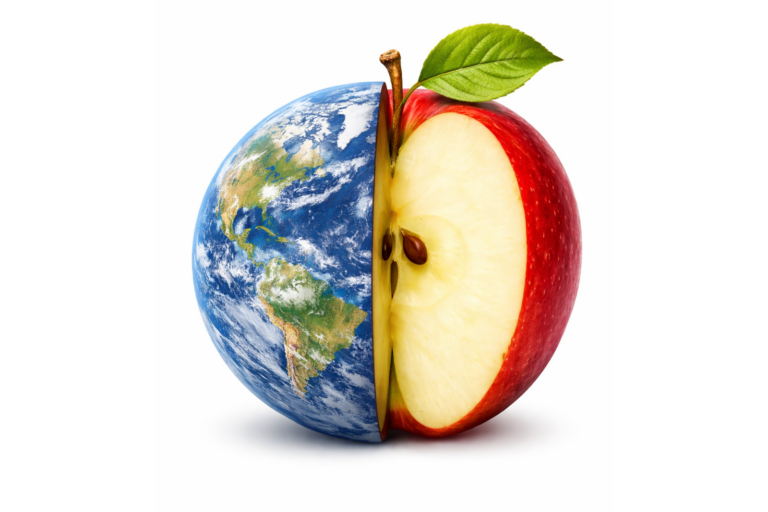
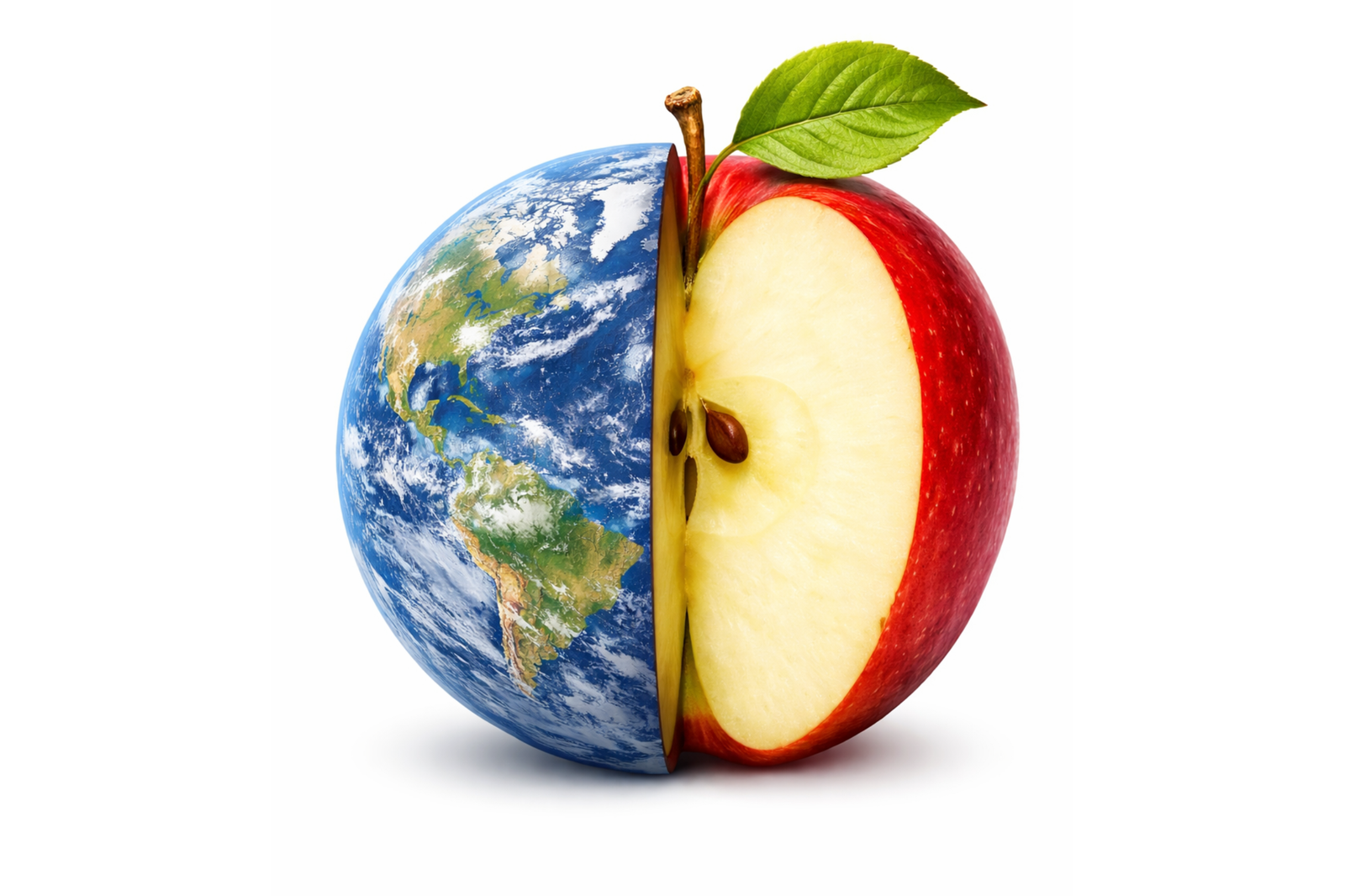
The apple skin analogy:
An apple has a diameter of ~8 cm and skin approximately ~0.3 mm thick.
Ratio: 0.3 mm / 80 mm = 0.375%
Living space vs. Earth:
- Theoretical: 0.073% (5× thinner than apple skin)
- Real: 0.000 46% (800× thinner than apple skin)
- Built-up: 0.000 003% (125,000× thinner than apple skin)
What This Means
The whole of human civilisation — all cities, villages, roads, croplands, buildings, factories, airports, ports — fits within a space amounting to approximately 5 million cubic kilometres.
That sounds like a lot. But it is 0.000 46% of the planet’s volume.
We speak of “mastering the Earth”, of the “Anthropocene”, of humanity’s impact on the planet.
Yet physically, we occupy a thousandth of a thousandth.
Even if we include all theoretical living space — +5.5 km upward, −1 km downward, all accessible land — it is still only 0.073%.
And in practice? We are concentrated in a thin layer near the ground surface, along beaten paths, in places where infrastructure leads.
A Closing Question
If all of humanity actually functions within a space of approximately 5 million km³ — what of the rest?
The rest exists. It is theoretically accessible. But there are no roads there, no infrastructure, no destination.
And perhaps that is precisely what defines human living space: not where we can survive, but where we actually are.
Living space is not only biology and physics.
It is also infrastructure, access, and purpose.