The Moon We Know — and the One We Don’t
Artemis 2 Is Coming (According to Plan)
Soon — if the schedule holds this time — four astronauts will fly around the Moon. Not land. Fly around it. The first crewed mission toward the Moon since 1972. Over half a century of absence.
The Artemis 2 launch has been postponed multiple times. The most recent target was February 2026, but a wet dress rehearsal revealed a hydrogen leak and issues with the helium system in the rocket’s upper stage. The vehicle was rolled back to the assembly building. The current date is no earlier than April 2026. The history of this mission is almost a textbook example of how difficult it is to leave Earth — before anyone has even left the ground.
The media is already spinning up. Elon Musk, who for years spoke primarily about colonizing Mars, is increasingly talking about the Moon — and not without reason, since Starship is ultimately meant to land there as part of Artemis 3. You can almost write the headlines in advance: “historic flight,” “humanity returns,” “a new era of exploration.” Before the mission launches, the narrative is already written.
But there’s one question that rarely gets asked in all this noise:
What do we actually know about the Moon?
The Illusion of Familiarity
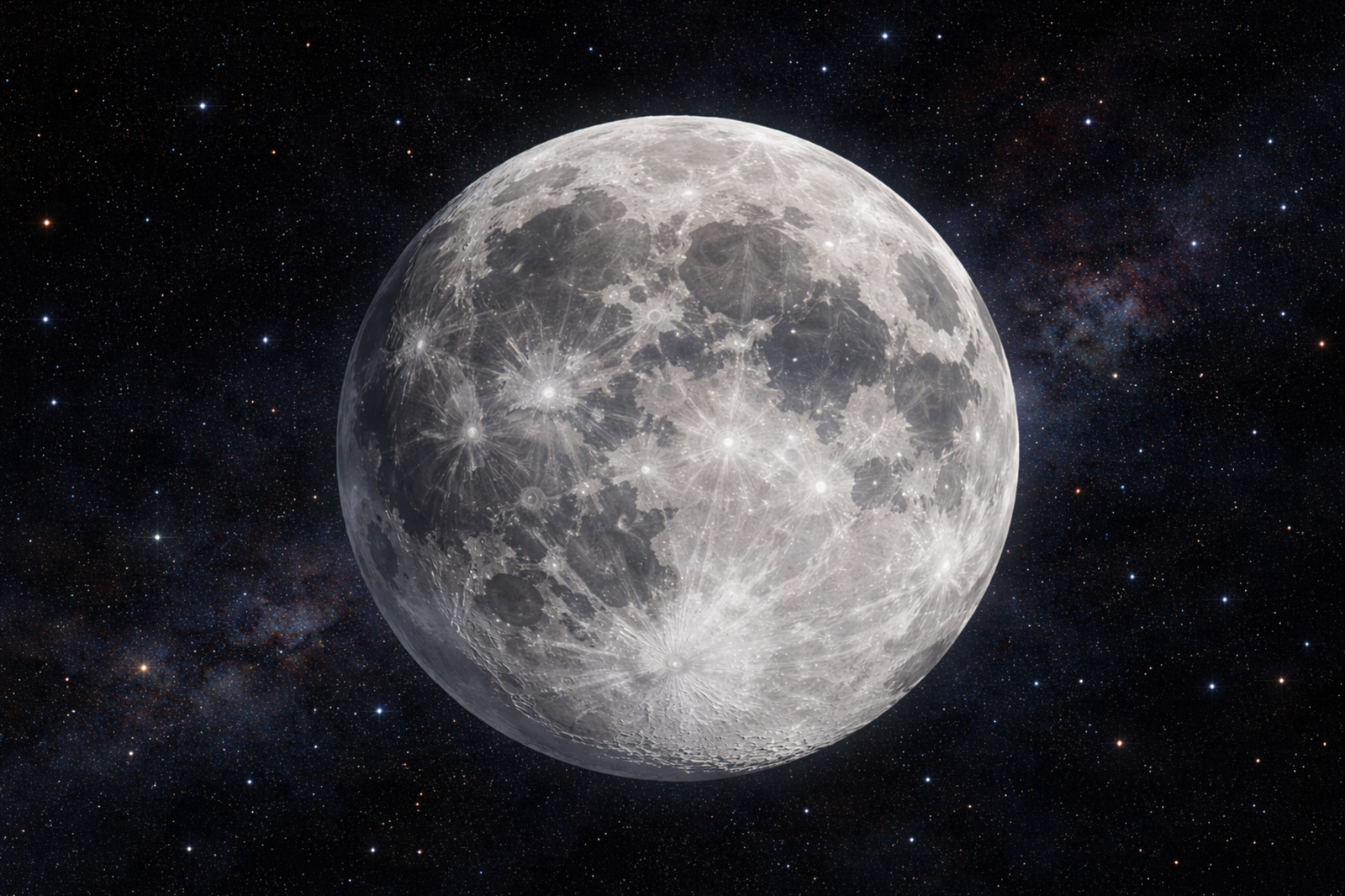
The Moon is the only celestial body beyond Earth where humans have set foot. We have rock samples, seismic data, hundreds of photographs, dozens of robotic missions. Our knowledge of the Moon seems — well — widespread.
And that’s exactly the trap.
In previous articles, we calculated how small the actual living space of humanity on Earth really is. How much we move along well-worn paths — literally and figuratively. The same pattern applies in science and popular knowledge: we know a lot about a few points, and everything else is a blank.
12 people landed on the Moon. All within three years. All near the equator. All Apollo missions combined collected samples from an area that is microscopic on the scale of the Moon.
We know a lot. But about a very small slice.
The Moon in 2025 — What Has Changed
Since Apollo, our understanding of the Moon has undergone a quiet revolution. Not through new landings — through new instruments, new orbital missions, new physics.
A few examples of what we know today that we didn’t know back then.
Water. There is ice on the Moon — preserved in permanent shadow at the bottoms of craters near the poles. This changes everything when it comes to long-term human presence.
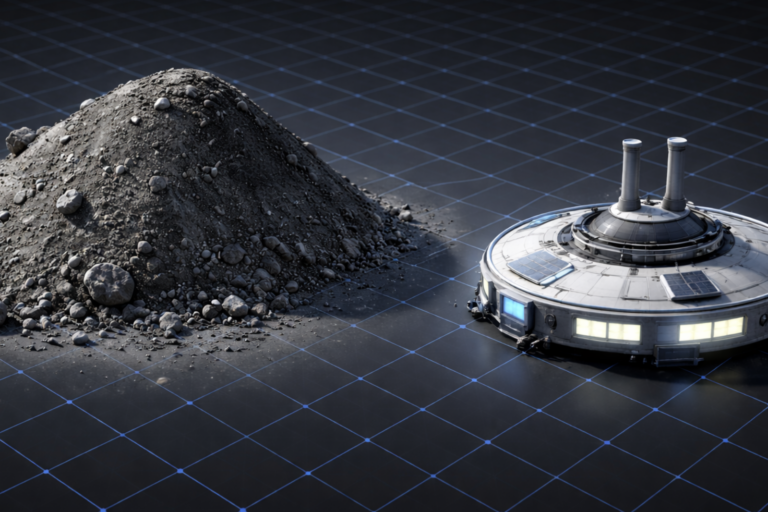
Regolith — but not the kind we imagine. That gray layer of dust covering the surface is not ordinary sand. It is a material that, over billions of years of meteorite bombardment and cosmic radiation, has acquired properties found nowhere on Earth. Properties with enormous practical significance.
“Times of day” — more extreme than anywhere on Earth. One lunar day lasts nearly a month. Temperatures swing by 300 degrees Celsius. For machines meant to operate there, this is an engineering challenge we have barely begun to understand.
These are not curiosities. They are the foundations on which all future missions will be built — including Artemis.
Where the Media Doesn’t Reach
Artemis 2 will be a massive media event. Rightly so — it genuinely matters. But the narrative will focus on people, emotions, the symbolism of return.
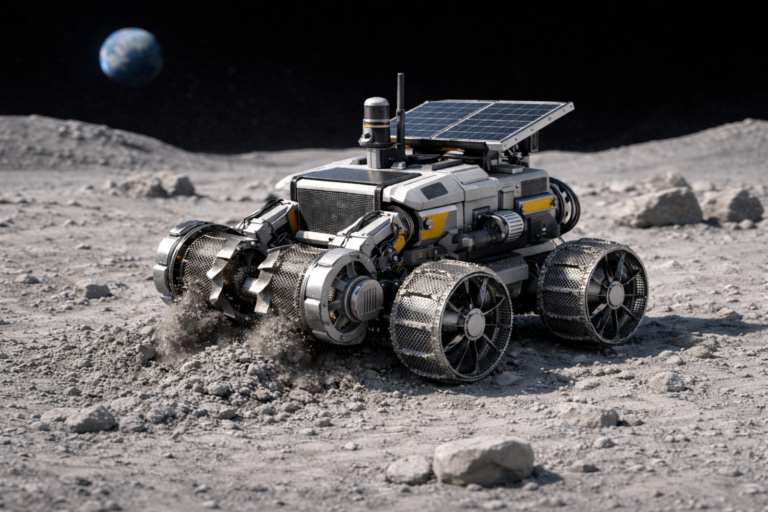
Less attention will go to what actually makes this time different from Apollo. Less to why the landing site is near the south pole and not the equator. Less to what to do with all that regolith that covers everything. And less to how absurdly difficult it is to survive on the Moon — not for humans, but for the machines that are supposed to make that presence possible.
These topics are pioneering — not because they are secret, but because they require connecting physics, engineering, and a certain kind of non-obvious thinking. They don’t make front pages.
Regolith — An Entry Point
Let’s start with what’s everywhere on the Moon and what tends to be treated as a problem.
Regolith. Gray dust. Rocks. At first glance — a sandbox.
But look closer, and it turns out this “sandbox” is one of the more interesting engineering materials available — provided you’re already on-site. That instead of shipping everything from Earth (which costs a fortune), you can use what’s lying at your feet.
This is ISRU — In-Situ Resource Utilization. One of the central paradigms of future missions. And regolith is its main character.
What can actually be done with it? What does it really look like, how does it differ from Earth’s soil, and why covering a habitat with it isn’t barbarism — but engineering sense?