Artemis II and What the Broadcast Doesn’t Show
Launch, orbit, the Moon. But somewhere between the broadcast and reality, there’s a layer worth seeing.
April 1, 2026, 22:35 UTC. SLS lifted Orion from Launch Pad 39B at Kennedy Space Center. On board: Reid Wiseman, Victor Glover, Christina Koch, and Jeremy Hansen — four people heading toward the Moon for the first time in over fifty years.
The media responded as expected. Live broadcasts, commentary, reports from mission control. “We’re going back to the Moon.” And that sentence is true. But if you listened to the broadcast carefully — especially if you listened instead of just watching — you might have heard something happening beneath that narrative.
The Procedure Nobody Announces
Dozens of minutes before launch: a sequence of short questions and answers between the flight director and each system station.
“Propulsion?” “Go.” “Guidance?” “Go.” “FIDO?” “Go.” “GNC?” “Go.”
For a viewer, this is a few seconds. Unrecognizable abbreviations, perhaps. Background noise before the real moment. But inside this procedure — the go/no-go poll — there’s something worth pausing on.
Each “go” is not a confirmation that everything is “fine.” It’s a declaration of responsibility. The person who says “go” for propulsion is saying: I know the state of the propulsion systems at this phase of the mission, I know the safety margins, I know the risk scenarios — and I take responsibility for that assessment. Not “seems okay to me.” I take responsibility.
And between the last “go” from a week ago and this one before launch, there were others. And others before those. Every rocket launch is not one moment of decision, but hundreds of them, spread across months.
Every Abbreviation Is Its Own Field
FIDO is the Flight Dynamics Officer — trajectory and orbit. GNC is Guidance, Navigation and Control — orientation and navigation in space. Behind each abbreviation stands not a “department,” but something closer to its own discipline of knowledge.
The SLS propulsion system — pressures, temperatures, micro-leaks in cryogenic fuel — is one niche. The guidance and navigation system — another. Long-range communication through the Deep Space Network — another. The thermal systems on Orion’s surface, which must survive the flyby near the Moon and atmospheric reentry on the way back — another. Mission control software — another.
Each of these areas represents knowledge that someone built over years in a very specific domain — knowledge that has no equivalent outside that domain. What an SLS propulsion specialist knows about the behavior of cryogenic hydrogen under pressure at ignition is not available in any condensed form. It is the result of years of work on this specific system, with this specific hardware.
And that person says “go” or “no-go.” No one else can do it for them.
The System No One Fully Grasps
This is the core of it.
A space mission is not one system. It is a network of systems — and a network of people who understand its fragments. Orion, SLS, the Deep Space Network, mission control, ground stations, life support systems, emergency procedures, the return plan — all of it must work simultaneously. And no single person grasps all of it.
That is not a weakness. It is a property of an architecture that works.
A rocket launch can be stopped by one person — the one who sees something in their domain that no one else understands well enough to evaluate. And that system — where a single “no-go” halts everything — is a deliberate design, not an accident.
The Viewer Who Changed
Something else happened during this broadcast, though it’s harder to see immediately.
Viewers are different from previous missions. Some of them know what a “hold” is and why it was called. Some follow telemetry and understand what the numbers on the screen mean. Some aren’t waiting for the launch moment, but for FIDO’s confirmation that the TLI trajectory is correct.
A new category has emerged: semi-experts. People who have never worked on a space mission but have built enough contextual knowledge that the broadcast is something more than a spectacle. This is the result of years of open data, specialist podcasts, available simulators, and detailed post-flight analyses.
Knowledge is traveling downward. Not necessarily deeply — but more broadly than ever before.
A Property of Scale
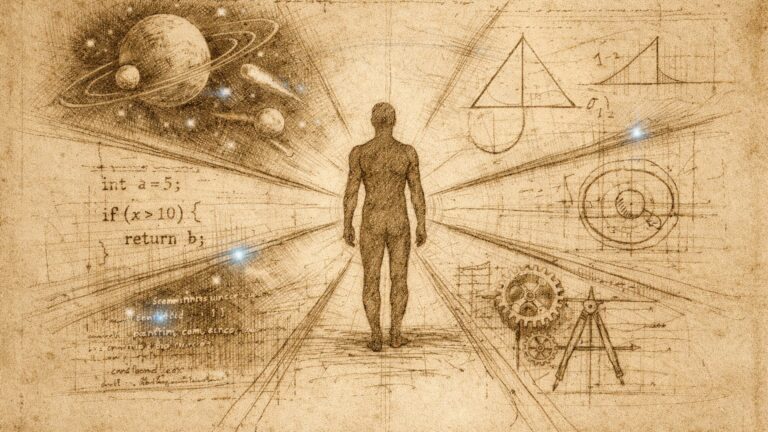
This architecture — a system made of niche specializations, where each fragment is understood only by the person who built it — appears beyond spaceflight.
In large AI systems, a similar principle holds at the level of infrastructure, training, and deployment. No one understands the whole. Everyone understands their fragment. The value lies in the network, not the center.
The more complex a system, the more it depends on knowledge that cannot be easily transferred. This is not a problem to be solved. It is a property of scale.
Somewhere in the World, Right Now
Media attention will follow Artemis II. April 6 — lunar flyby. Four people near the Moon’s surface for the first time in over fifty years. Then the return and splashdown in the Pacific. More headlines.
But somewhere, disconnected from that calendar, someone today is sitting with life support system data for a future landing mission. Someone else is running thermal models for Orion’s heat shield under conditions that Artemis II is only now testing for the first time in practice. Someone else is working on an autonomous navigation system for the lunar surface — a problem that won’t appear in any broadcast for years, because it still needs several more layers of solved problems beneath it.
None of these people will appear in the mission coverage.
And that is precisely why, for a human to land on the Moon, all of them will one day have to say “go.”
Artemis II is the first mission in over fifty years with humans heading toward the Moon. Crew: Reid Wiseman, Victor Glover, Christina Koch (NASA) and Jeremy Hansen (CSA). Launch: April 1, 2026, 22:35 UTC. Mission duration: approximately 10 days.
Article developed in collaboration with Claude (Anthropic).