Regolith Shielding: The 500-Ton Elephant in the Room
In theory, every serious lunar habitat design assumes a regolith layer for protection. In renders and presentations, it vanishes. This gap between physics and vision reveals something important about where we actually stand.
Where We Left Off
In the previous article, I ended with a question: what can actually be done with regolith — that gray dust covering the Moon’s surface?
The standard answer sounds simple. Use it as shielding. Pile it on top of your habitat. Protection from radiation, micrometeoroids, and thermal extremes — all from material that’s already there.
This is ISRU at its most elegant: instead of launching mass from Earth at enormous cost, you use what’s lying at your feet.
But here’s what bothers me.
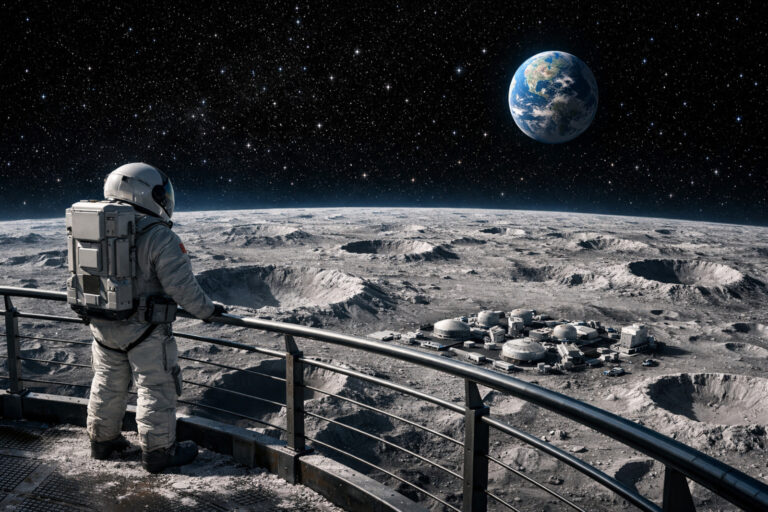
I’ve looked at dozens of habitat concepts, renders, architectural visions of lunar bases. Sleek modules. Inflatable structures. Glass domes. Astronauts walking on pristine surfaces.
Almost none of them show the regolith layer.
Why?
The Gap Between Physics and Vision
In engineering literature, regolith shielding is nearly standard. Studies consistently recommend around 2 meters of regolith as minimum protection for long-term human presence. Some analyses go further — 3 meters or more for optimal radiation shielding.
This isn’t speculation. It’s based on decades of research into how lunar soil interacts with cosmic radiation, solar particle events, and hypervelocity impacts.
Yet in visual representations — the images that shape public understanding, that appear in presentations and media — the regolith disappears.
The reasons are surprisingly mundane.
Renders show the structure, not the environment. Architectural drawings focus on the module, the connections, the engineering. Regolith is treated as “site work” — something that happens later, not part of the design itself.
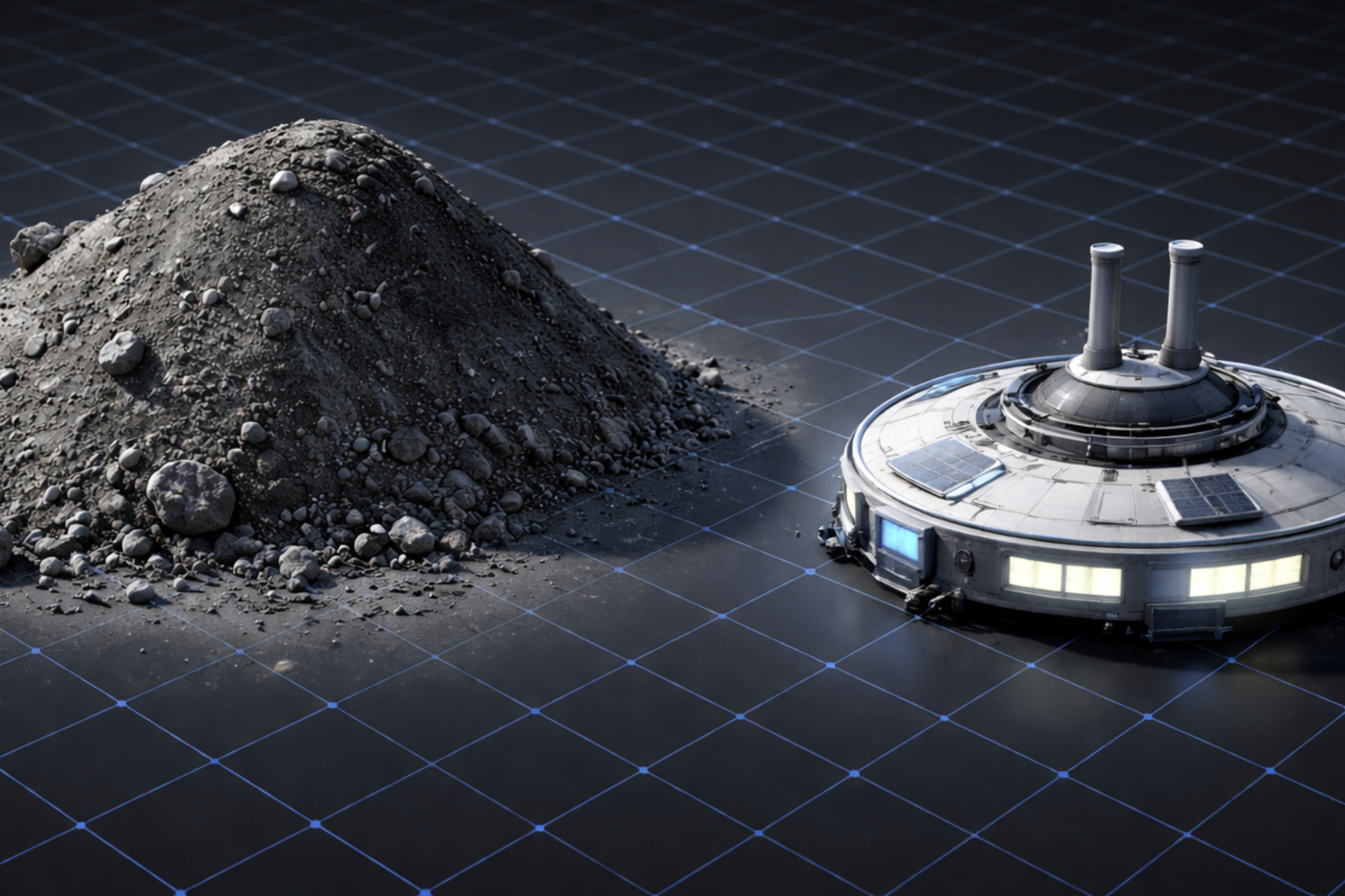
Marketing wants to show the habitat, not a dirt mound. A realistic base covered in 3 meters of regolith would look like a low hill with an airlock sticking out. Not exactly the futuristic vision that excites investors and the public.
Concepts show Phase 1, not the final state. Many designs assume: first land the module, then robots pile regolith on top. The render shows step one. The physics requires step two.
This creates a strange situation. The engineering community knows regolith shielding is essential. The public sees images without it. And almost no one talks about this disconnect explicitly.
The Mass Nobody Mentions
Let me put some numbers to this.
A typical habitat concept might have a diameter of 8-10 meters. If you need to cover it with 2-3 meters of regolith for adequate protection, you’re looking at:
At least 500 to over 1,000 tons of material.
Around a single module.
(These numbers are approximate — they depend on habitat geometry, slope angle, and regolith density. But the proportion holds: the shielding layer weighs ten to thirty times more than the module itself.)
This isn’t a detail. This is the dominant mass of the entire structure. The habitat itself — the pressurized module, the life support, all the equipment — might weigh 20-40 tons. The regolith layer weighs ten to twenty times more.
Think about what this means operationally.
Someone has to move that material. Excavate it. Transport it. Place it precisely. Compact it. Ensure it doesn’t slide off. Ensure it doesn’t damage the structure beneath. Ensure the process doesn’t kick up dust that degrades every surface it touches.
This isn’t architecture. This is mining. Civil engineering. Earthwork — or rather, regolith-work — on a scale that dwarfs the habitat construction itself.
And yet, when we talk about lunar bases, we talk about the modules. The inflatable structures. The 3D-printed components. The regolith layer is mentioned in passing, if at all.
Why Shielding Matters (The Updated Physics)
Let me be precise about what we’re protecting against. The numbers have been refined significantly since Apollo.
Radiation comes in two flavors with very different characteristics.
Solar Particle Events (SPEs) are acute — intense bursts during solar storms. Recent research shows that just 4 g/cm² of regolith reduces doses below 30-day limits. With 10 g/cm², you have a safety margin of two.
Galactic Cosmic Radiation (GCR) is chronic — constant, penetrating, and harder to stop. Here’s where it gets counterintuitive: adding more shielding doesn’t always help. At around 180 g/cm² of regolith, the annual dose is only about 25% lower than an unshielded environment.
Why? Because high-energy particles hitting regolith produce secondary radiation — neutrons and other particles that can be more biologically damaging than the primary radiation. Studies show that beyond about 45 g/cm², the production of secondary particles begins to offset the protection gained.
This is critical. More is not always better. There’s an optimum thickness, and it’s not “as much as possible.”
Micrometeoroids are the silent threat. A 2025 analysis calculated that a lunar base the size of the International Space Station would experience 15,000-23,000 impacts per year from particles ranging from a millionth of a gram to 10 grams.
The good news: current Whipple shield technology can reduce this threat by nearly five orders of magnitude. The question is whether you use shielding brought from Earth (expensive, proven) or regolith piled on-site (cheap, complex to implement).
Thermal cycling is perhaps underappreciated. The lunar surface swings nearly 300°C between day and night. One lunar day lasts about 29 Earth days — roughly 14 days of continuous heating, then 14 days of continuous cooling.
Regolith acts as thermal mass, damping these swings. But this only matters for long-duration stays. For a two-week mission, active thermal management is simpler than burying your habitat.
The Polar Exception (With a Caveat)
You’ve probably heard about the “peaks of eternal light” — spots near the lunar poles that are almost always sunlit.
This changes the calculation significantly. If you’re in near-constant sunlight:
- Thermal swings are much smaller
- Solar power is continuously available
- The 14-day night survival problem disappears
But here’s the caveat that often gets lost: there are no true peaks of eternal light.
The most favorable locations — ridges on the rim of Shackleton Crater at the south pole — receive sunlight about 94% of the lunar year. That’s remarkable, but it’s not 100%. The longest continuous darkness at these sites is about 43 hours.
More importantly, being in near-constant sunlight doesn’t eliminate the other threats. Radiation and micrometeoroids don’t care about illumination. The regolith shielding question remains — it just becomes somewhat less urgent as a thermal solution.
This is why the lunar south pole is the target for Artemis. Not because it solves all problems, but because it solves some of the hardest ones.
Why It’s Not Happening Yet
If regolith shielding is so well-understood, why isn’t it being implemented?
The answer is sequencing.
Current and near-term lunar missions are designed for:
- Short stays (days to weeks)
- Demonstration objectives
- Episodic operations, not continuous presence
In this timeframe, the threats that regolith addresses — cumulative radiation damage, long-term thermal cycling, statistical micrometeoroid degradation — don’t reach critical thresholds.
The missions are designed to succeed, not to last 20 years.
More fundamentally, there’s a logical order to exploration:
Phase 0-1: Landing. Orientation. Basic mobility. Power. Communication. “Can we operate here at all?”
Phase 2+: Earthwork. Mass movement. Infrastructure construction. “Can we build here?”
You can’t design regolith shielding sensibly if you don’t yet know:
- How reliably you can move across the surface
- What it actually costs to move a ton of regolith
- How durable your construction robots are
The habitat designs exist. The shielding calculations exist. What doesn’t exist yet is the operational experience to connect them.
This isn’t a failure of imagination or engineering. It’s the natural sequence of learning to operate in a new environment.
Mining, Not Architecture
Here’s what I think gets lost in most discussions of lunar bases.
We imagine the challenge as designing the habitat — the pressurized volume where people live and work. That’s the exciting part. That’s what goes in the renders.
But the actual construction challenge, measured by mass moved and work performed, is the regolith layer. The excavation. The transport. The placement. The 500 tons of material that have to go on top of your 40-ton module.
Designing a lunar habitat is aerospace engineering.
Building a lunar habitat is mining.
The organizations that will succeed at long-term lunar presence aren’t necessarily the ones with the best module designs. They’re the ones that figure out regolith-moving at scale.
This is a different skillset. Different equipment. Different operational philosophy. And it gets almost no attention compared to the habitat itself.
The Timeline
When will regolith shielding actually matter?
Artemis 2 — the mission that might launch in April 2026 — is a flyby. No landing.
Artemis 3 has been restructured. Current plans call for testing the lunar landers in Earth orbit in 2027. The first crewed landing is now targeted for Artemis 4 in 2028, with astronauts spending about a week on the surface.
A week. At the south pole. With the equipment they bring with them.
Regolith shielding isn’t relevant for this mission. The exposure is too short. The operational complexity is too high. The point is to demonstrate landing and surface operations, not construction.
For longer stays — months, then years — the calculation changes. Cumulative radiation becomes a real constraint. Micrometeoroid degradation starts to matter. Thermal management for full day-night cycles becomes essential.
That’s when regolith transitions from “future consideration” to “operational requirement.”
My estimate: we’re at least a decade from missions where regolith shielding moves from concept to implementation. Probably longer.
What This Means
Regolith as shielding is not a mystery. The physics is understood. The engineering approaches exist. The need is well-documented.
What’s missing is the bridge between knowing and doing.
That bridge requires:
- Operational experience on the lunar surface
- Reliable excavation and transport capability
- Clear requirements (how long does the base need to last?)
- Economic justification (who pays for the robots and the time?)
Until those pieces are in place, regolith shielding will remain what it is today: a solved problem on paper, waiting for the infrastructure to make it real.
In the meantime, we’ll keep seeing renders of sleek modules on pristine lunar surfaces. Visions that are physically incomplete — but perhaps necessarily so. You have to imagine the destination before you can plan the journey.
Just don’t mistake the render for the reality. The real lunar base, when it comes, will look more like a construction site than a space station.
And somewhere under all that gray dust will be the habitat we actually designed.
This article continues the lunar exploration series on AI907. Previous: The Moon We Know — and the One We Don’t
Article developed in collaboration with Claude (Anthropic) — demonstrating how human-AI collaboration enables deep exploration of complex engineering topics.